The Write Stuff: Columnist Brian O'Neill
Abby Mendelson
Wednesday, January 14, 2009
One way to more easily provide government services would be freeing up tens of millions of dollars from the lawmakers serving themselves.Then we might lead the nation in something better.I'm just saying.“We just have to do a lot of things more wisely,” Brian O’Neill muses one rainy autumn morning, his hands wrapped around his ever-present mug of coffee. “In my column I try to concentrate on Pittsburgh and Pennsylvania. I think things” – such as better urban design, improved rail service, and a smaller state legislature – “are going to happen because they have to happen. Not because of me.”
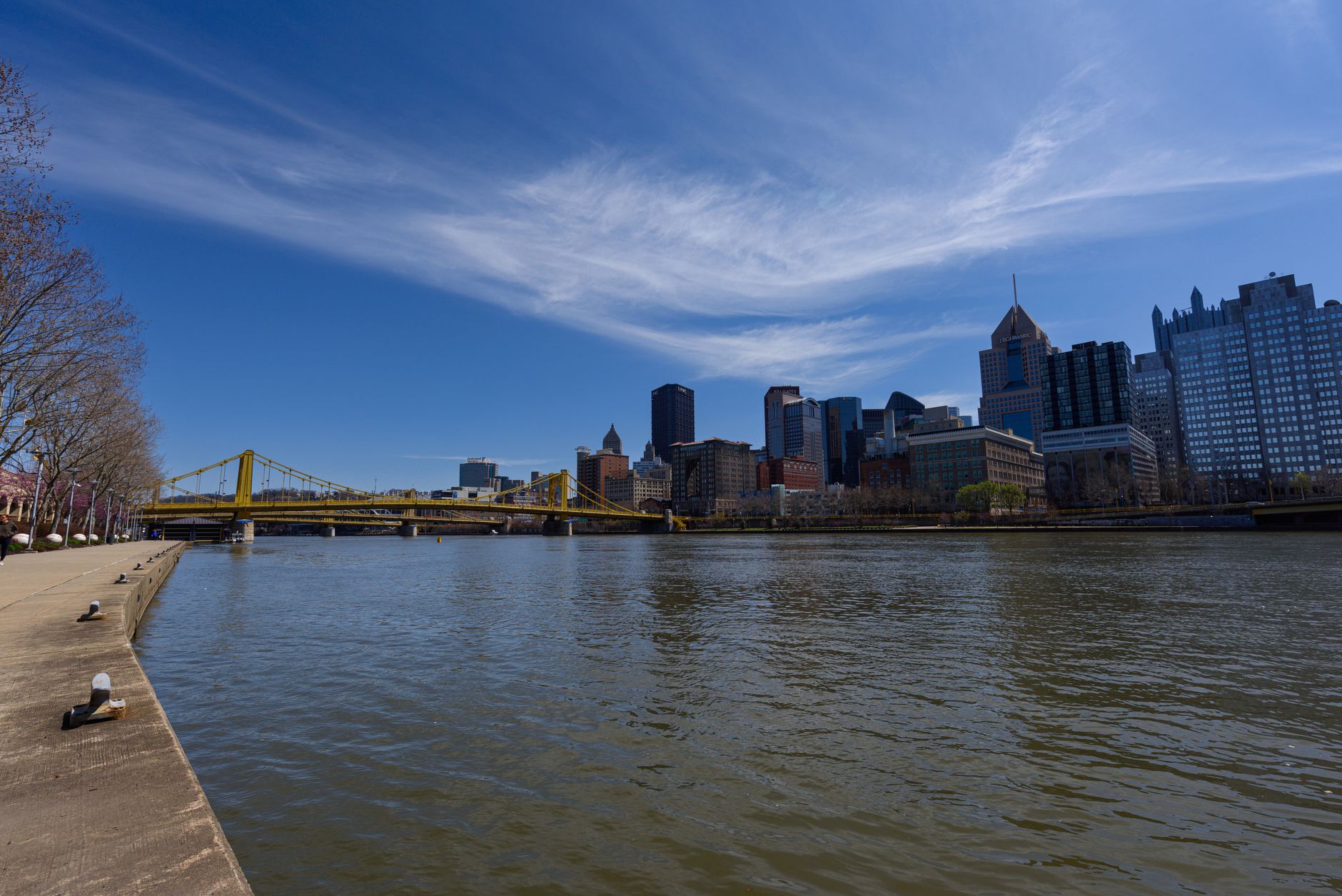
Maybe yes, maybe no. Arguably Pittsburgh’s most influential newspaper columnist for the past two decades, O’Neill has a way of getting his ideas into the public consciousness and making them stick. For example, his campaigns to alter the Occupation Tax (spreading it out over a year instead of taking it all at once) and to open the Clemente Bridge for foot traffic during
Pirate games were both highly publicized – and highly successful. “Sometimes there are small victories,” he shrugs – which, along with the coffee, is something O’Neill does a lot. “I don’t know how much I’ve written matters.”
No metaphor for the demise of American rail travel beats the streetscape just off Liberty Avenue. There is The Pennsylvanian, once the grand station for the Pennsylvania Railroad and now a luxury apartment building. The Amtrak station hides below it, almost apologetically, with all the charm that plastic chairs and vending machines can offer.O’Neill comes by his advocacy honestly. Growing up in Carle Place, on suburban Long Island, he cut his teeth reading classic New York columnists Jimmy Breslin and Pete Hamill. Like O’Neill, they’re scions of the city’s Irish working class; like O’Neill, they’re wryly humorous, sharp observers who write straight-from-the-heart pieces laced with street smarts and common sense.
The son of a postal worker, neighbor to landscapers and sanitation workers, O’Neill’s first job, fittingly enough, was delivering Newsday, a Long Island daily. Writing for the high school paper, he went to Syracuse, for a journalism degree, then to Virginia – Danville and Roanoke – where by 1983 he was writing a column, meaning that rather than merely report the news, his could provide his own take on things.
In 1988, hearing about an opening for a columnist at the now-defunct Pittsburgh Press, O’Neill applied. His pitch: “a columnist,” he wrote to then-editor Angus McEachran, “should not be judged by how many awards he’s won, but rather by how many refrigerator doors his columns are posted on.” McEachran, a notoriously tough sell, hired him.
“I connected right away,” O’Neill recalls. “I got Pittsburgh right away. It had everything – professional sports. Neighborhoods and neighborhood bars. Theater. People who recognize St. Patrick’s Day as a holiday.”
When the Press went under, O’Neill moved over to the
Post-Gazette, January, 1993.
Illinois and Ohio are nearby, about our size and have comparable urban/rural splits, and they manage to run their Houses with just 118 and 99 state representatives, respectively. I'd bet my lunch money that no voter in Peoria or Akron is thinking their lives would get better if only they'd hire more lawmakers.O’Neill lives comfortably, in a 140-year-old Allegheny West house (“my third, and last,” he says, “within a half-mile radius”) complete with gas fireplaces and 15-foot ceilings. Sharing quarters with his wife, Dr. Betsy Blazek O'Neill, an
Allegheny General physiatrist, two grade-school daughters, and Ted, the world’s most rambunctious bowser, O’Neill et famille walk a lot -- to work, school, West Park, Pirate games, the North Side Charm Bracelet (the
Carnegie Science Center,
Aviary,
Children’s Museum, and so on). “It’s patriotic,” he says.
In his column, and in The Paris of Appalachia, a book forthcoming from
CMU Press, O’Neill writes about what he calls “the far middle. I like telling stories. I like the people I meet. People connect with those people. They feel better about the world.” Another O’Neill shrug. “Maybe.”
The old asphalt sea surrounding Three Rivers Stadium is now the site of office buildings, restaurants and a hotel, not least because the city brought back much of the original street grid obliterated in the 1960s.“I’m lucky to have a job where I’m able to speak out on things,” O’Neill says. “Train travel, for example,” he turns a hand, “is going to make more and more sense as the cost of fuel goes up.” He sips. “Public policy can be very dry – but it affects our lives. So Harrisburg -- we have America’s largest full-time legislature grabbing money with both hands. That means less money for the right stuff. We’re spending it on the wrong stuff.”
Those kinds of opinions, offered by a fair-minded ombudsman, a kind of vox populus, have rendered O’Neill required reading for everyone from pols to stay-at-home-moms. Tapping out three columns a week – some 150 annually – O’Neill prefers to interview in person, then do his writing at the Post-Gazette office, Downtown. “There’s an energy that I get there,” he says.
“I try to write entertaining columns,” O’Neill adds. “If I can write something that’s helpful to people, that’s great. But I can’t only write columns that say, ‘wouldn’t it be great if we did something!’ I’ve got to change speeds. Who has 150 strong opinions a year? Not me.”
America needs to do what I did. We need to invest in more 19th-century technology as the age of cheap gasoline fades in the rear-view mirror. We need more rail capacity.“People want something conversational from my columns,” he says, “a story with a beginning, middle, and end -- a finite length. ‘O’Neill? OK, I’ll give him five minutes.’” The region’s top columnist pauses, shrugs, then states his oft-repeated refrain. “‘Maybe.’”
House Republican Leader Sam Smith of Punxsutawney has argued a smaller Legislature wouldn't save much because the size of each lawmaker's staff would have to grow to handle the increased workload. That's hooey. The number of legislative staffers more than doubled between 1979 and 2003, going from 1,430 workers to 2,947. That's almost six times the number in Ohio and more than three times the staff in Illinois. Their capitols haven't crumbled.
To receive Pop City weekly, click here.
Abby Mendelson’s latest book, End of the Road, a collection of short stories, is available at amazon and bn.com.
Photographs copyright Brian Cohen