Designing Pittsburgh for the 21st Century
Abby Mendelson
Wednesday, February 27, 2008
“Our goal,”
Urban Design Associates tells its customers, “is to create beautiful places with lasting value for the communities they serve.”
A true international player, with projects in Pittsburgh and beyond -- in Portland and Portsmouth; Belize and Nicaragua; Scotland and the former Soviet Union; Canada and France – their designs “build on the unique character and positive qualities inherited by each place.”
Don Carter, a gentle, gifted man, has helped guide UDA for more than 30 years, from its early days in Oakland to its present space, a 31st Floor aerie atop Downtown’s Gulf Tower. Raised in East Liberty, graduated from Peabody High School and Carnegie Mellon,
Carter has lived in Washington, Monterey, Philadelphia, and Edinburgh; raised a family in Regent Square; and moved Downtown, into The Pennsylvanian (the retrofitted Pennsylvania Railroad Station). A trim, fit man, he walks two blocks to work, revels in Downtown life, and regularly bikes about the city and beyond.
Having lectured, published, and practiced internationally, Carter’s upcoming gig will be as moderator at
Carnegie Mellon’s Cornerstone conference,
How to Build a Great City in the 21st Century: Entrepreneurial Pittsburgh. On March 24, Carter, along with presenters from Spain, Qatar, Japan, and Pittsburgh, will tackle the topic of “Designing a New City – Pittsburgh – for the 21st Century.”
Now, nearly a decade into the new century, Carter reflects, Pittsburgh has already added two stadia, seen the rise of the Cultural District, enjoyed a significant spike in Downtown housing – with more to come. “You can go to virtually any medium-sized city and not find this much richness and diversity, including dining and retail,” he says.
Eight Things to Make it GreatWhat about this place, this city called Pittsburgh? We’re making it green, wiring it for everything. How can we make it better? How can we build the 21st-century city? Carter makes eight points:
Walking. “Don’t throw away the lessons of the past,” he says, re-stating the UDA credo. “Mixed-use, pedestrian-friendly cities, like Pittsburgh, are part of the great American tradition. The American grid meant walking to work, school, and shopping. People had to live that way, and it’s still the best model. Vibrancy can only happen with people in gathering places. People gravitate to cosmopolitan life, to a sense of place.”
Technology. Currently, some 4,500 people like Carter live Downtown – with more to come. “I don’t think the 21st Century has to be space age, here or anywhere else,” he says. “It has to be human, and technology is not necessarily a negative for cities. If technology means that people disaggregate, then cities will die. But that’s not what’s happening here. It’s just the opposite. We may spend more time than ever in front of computers, but people also go where there are people – to sports events, museums, theater. Even to cafes and libraries where there are rooms of people on computers. Having computer-friendly environments will draw people.”
Diversity. “Creative people,” Carter says, “want to be in places where there are other creative people. To grow cities like Pittsburgh, we have to create places where creative people feel comfortable. To do that, we have to celebrate diversity. Mono-cultural societies will not attract talented people. We need a critical mass of talent – and it has to be real.”
Recruitment. “We need to go out and recruit the best and the brightest,” Carter says. “Bring them into town for a weekend. Take them out to dinner on Friday night. Shopping in the Strip District on Saturday. The South Side on Saturday night. Fallingwater on Sunday. All we have to do is get them here for a weekend and turn them loose. Pittsburgh will sell itself.”
Assets. “We need to emphasize our assets,” Carter says, “our universities, our history of entrepreneurship. We have beautiful neighborhoods and great cultural attractions -- like no other city in the United States. Google, Microsoft, and Apple are already here. Let’s use all we have to attract other people and other cultures.”
Immigration. Pittsburgh, Carter contends, should be a prime market for the foreign-born – just as it was a century ago. “This group accounts for some 40 percent of New York City,” he says, “but just two percent here. From Eastern Europe to the Indian subcontinent to Latin America, we have to become more immigrant friendly.”
Fellowships. Postulating that “we can jumpstart something with creativity,” Carter calls for fellowships for sculptors, filmmakers – artists of all sorts. “Send out a signal,” he says, “‘if you’re creative, the one place you want to be is Pittsburgh. And we’ll support you.’” After all, he adds, all great cities – from Pericles’ Athens to de Medici’s Florence -- had a symbiotic relationship of commerce and art. “We don’t have to re-invent that,” Carter asserts. “Frick, Mellon, Carnegie – they are our original energy source for creativity.”
Branding. “My fear is that we are not going to be bold enough at a time which requires extraordinary vision and commitment to change,” Carter wrote at the end of 1997. “There must be a central metaphor, an exciting concept, which will capture the minds of all the citizen of the region, as well as the attention of the world.” A decade later, he has taken to calling Pittsburgh the Digital City, making the switched-on ‘Burgh the symbol – and ultimate selling point -- in re-casting the Pittsburgh of the 21st Century.
Looking to the future, Carter gazes into the past. “I believe the key to Pittsburgh’s economic future is in recognizing the treasure trove we have in our built and natural environment,” he says. “The quality of life in the neighborhoods will attract the knowledge workers and entrepreneurs we need to drive the economy. People crave authenticity – and authenticity is in the very bones and genes of this town and its people.”
Abby Mendelson’s latest book,
Ghost Dancer, a collection of short stories, is available at amazon and bn.com.
Captions:
Don Carter in the Gulf Tower offices
Bicycles at PPG Plaza downtown
Don Carter sharing his thoughts on Pittsburgh
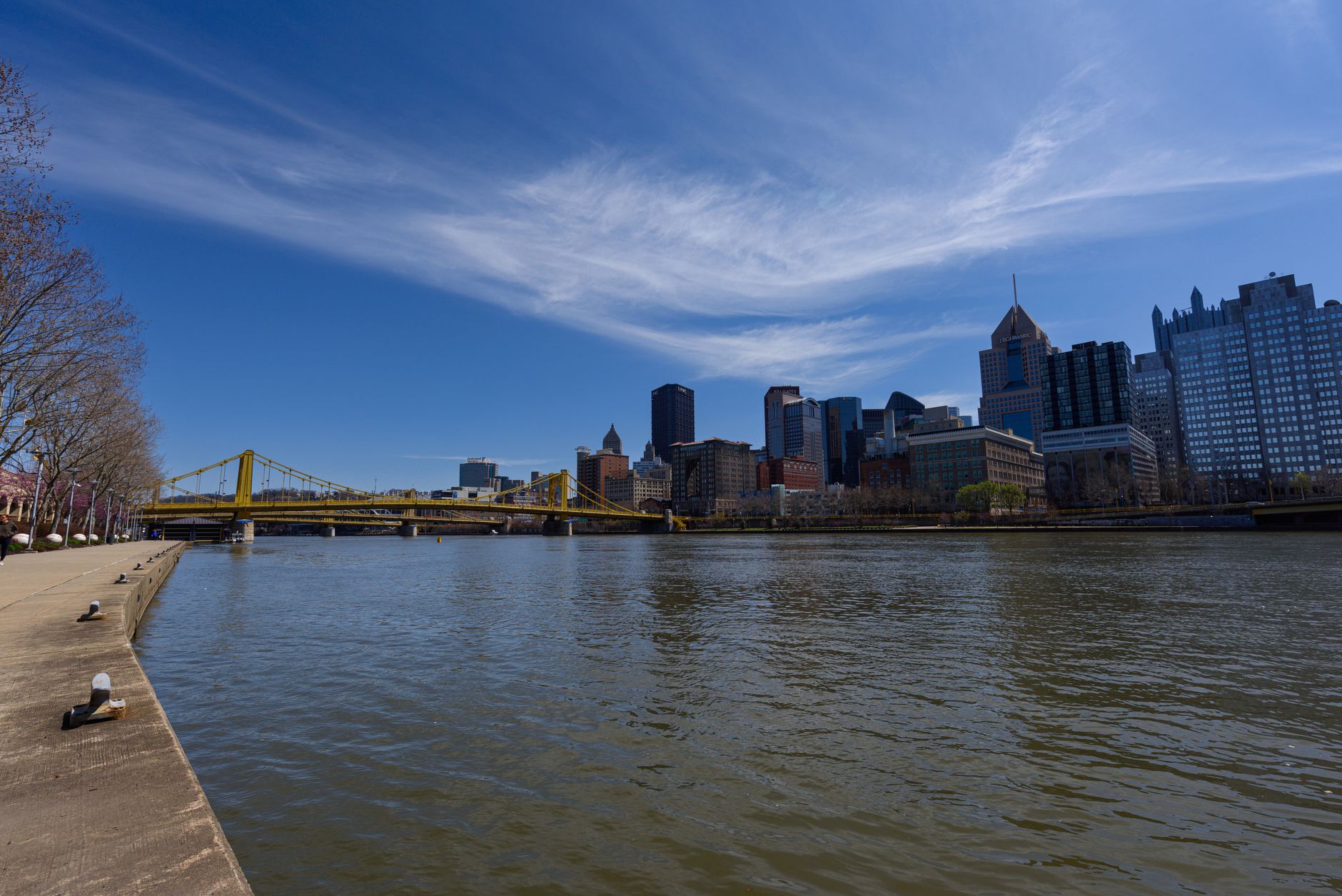
Downtown from the confluence
Carter outside the Pennsylvanian where he lives
All photographs copyright Brian Cohen