Wednesday, March 17, 2010 | Follow Us:
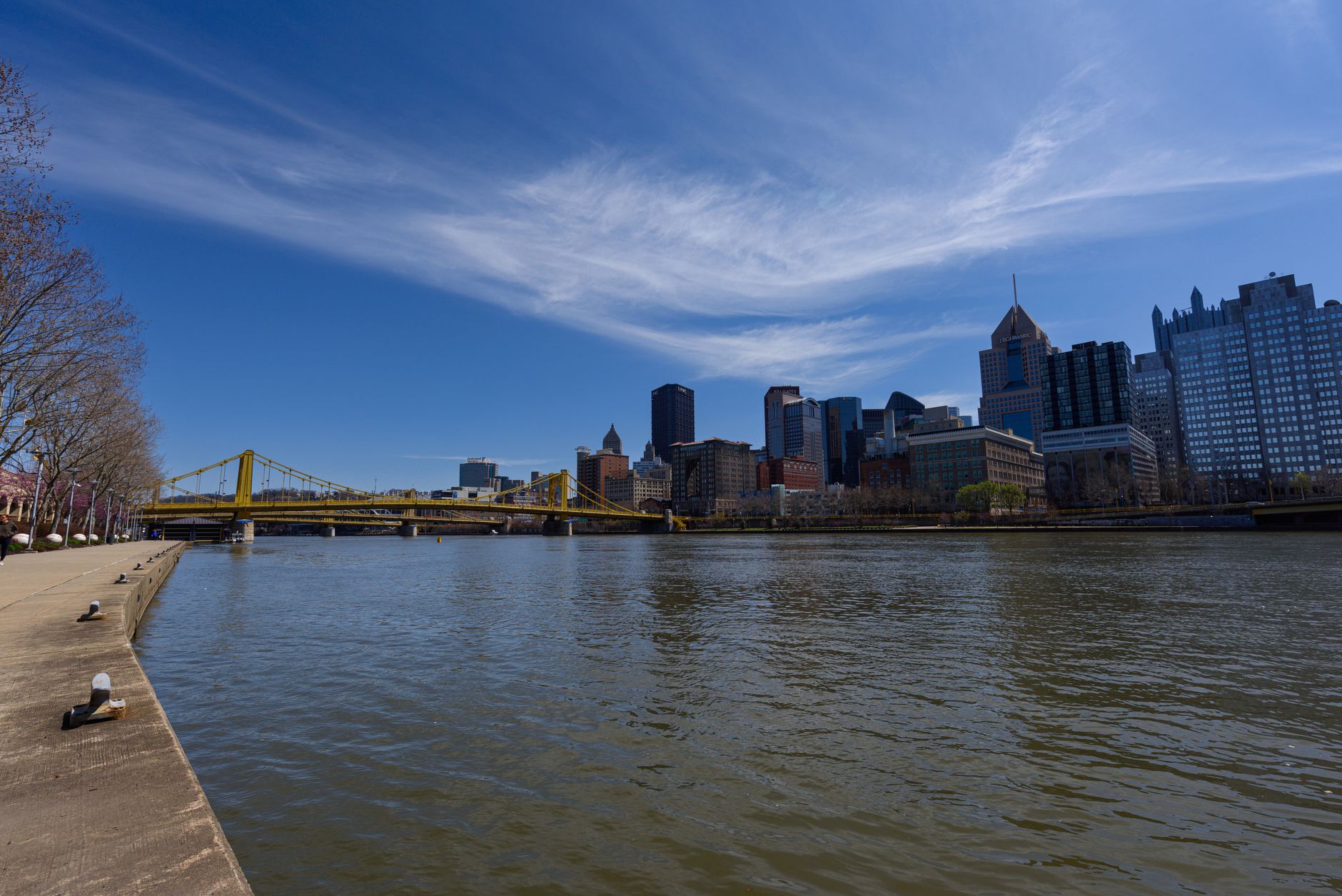
The Baltimore and Ohio Rail Bridge Reflected in the Monongahela River.  Photograph Brian Cohen
The Baltimore and Ohio Rail Bridge Reflected in the Monongahela River. Photograph Brian Cohen

Features

Celebrating African American Culture

Soon the Pittsburgh Cultural District will sport a dramatic new gateway. With its unusual shape on an unusually shaped triangular lot, the new 80,000 square foot building for the August Wilson Center for African American Culture will be completed in September, 2007. And it will make a statement. The tall, bowed structure of metal and glass on the corner of Liberty Avenue and 10th Street, will appear to push out from the rectangular planes of the adjacent facades as if, they say, the energy of African American culture contained within were bursting forth into the city.

One thing is certain: it will fill a void. “The August Wilson Center is hugely important for the city and region for a number of reasons,” says Janet Sarbaugh, senior program director of the arts and culture program for the Heinz Endowments which is funding the Center. “It highlights the contributions of African Americans to American culture – a part of Pittsburgh’s cultural life and history that has not been adequately recognized in the past. Secondly, the presence of this new institution signals a greater commitment in Pittsburgh to diversity and to inclusion, and positions us as a 21st Century community."

What's more, as beautiful as the building will be, it's only as good as the programming that’s in it, she adds. "We believe that the programming philosophy will be unique in the country.” In addition to contributing $4 million to the building’s capital campaign, the Heinz Endowments has also committed to annual operating support.

The new building will include permanent and changing art galleries, a 500-seat theater, a 1,500-seat music cafe, classrooms, a gift shop, and a variety of multi-purpose spaces to be used for visual and performing expressions. These multi-purpose spaces will also be available for rental and use by the community. “It’s going to be a part of the real community fabric of the Cultural District,” says Sarbaugh, noting that this sense of a hybrid “will give it a kind of liveliness that will make it very unique.”

"By serving as a magnet to draw diverse groups of tourists, the Center will be an economic driver for the region," says Neal Barclay, president and CEO. The holistic approach--celebrating African culture of every manner all under one roof--will make it a unique world-class attraction, he adds. "The August Wilson Center for African American Culture will be a meeting place for people of all cultures.”

The Building

Architect Allison G. Williams, FAIA is the creative force behind the new facility. Chosen from 16 candidates in a national design competition, Williams is principal with the San Francisco-based architecture firm Perkins+Will, and is one of a few African American architects working in the field of civic buildings and cultural facilities.

To underscore the Center’s identity as a civic building and to recognize the street as a vibrant arena for African American culture, the ground floor will be treated as an extension of the street. The Liberty Avenue facade will principally be glass—transparent, translucent, and opaque with the majority of the public spaces oriented toward Liberty Avenue with the activity inside serving as another visual element of the Center.

This hybrid space will allow the Center to showcase the range of African American expression in one central location, to promote a broader understanding of African American culture, says Heather Clark, director of marketing and communications at the Center. She noted that many forms of African American cultural expression, from gospel to hip hop, are interdisciplinary by nature. “It’s important to tell stories and to look at them visually and performing,” she says.

The idea of creating an African American cultural center in Pittsburgh emerged a decade ago when Mayor Tom Murphy issued a challenge to City Council Members Valerie McDonald and Sala Udin. In 2002, the African American Cultural Center of Greater Pittsburgh (AACC) was incorporated as a non-profit organization and it now resides in the Regional Enterprise Tower downtown until the new building opens.

Now in its third acclaimed season of diverse programming, the Center presents and co-presents productions at theaters in the Cultural District and in neighborhoods throughout Pittsburgh. The 2005-2006 season concludes with “Looking Forward,” an exhibit of Teenie Harris’ photographs of children and youth on view now through July 15th at the Center’s art gallery at 209 Ninth St. in the Cultural District. Recent programs included an evening with film director Spike Lee, music concerts, dance presentations and a traditional African puppet show.

A new name

In February 2006, the Center announced its new name, in honor of the Pittsburgh playwright, August Wilson. Before his death from liver cancer in October 2005, Wilson and AACC board members were exploring partnership ideas, with plans to talk again after Wilson completed “Radio Golf.” Sadly, this would be his final play, as he was diagnosed in the summer and died several months later.


Wilson, a Pittsburgh native, was the first African American to have two plays running simultaneously on Broadway and is one of seven American playwrights to win two Pulitzer Prizes. His most celebrated achievement is a 10-play cycle, known as the Pittsburgh Cycle, which depicts the comedy and tragedy of the African American experience in the 20th century. Each play is set in a different decade, and nine of the 10 are set in Pittsburgh’s Hill District, where Wilson grew up. “Because of who he is and because of what we are…we felt the need to make sure we were appropriately honoring him,” says Clark.

Reaching the Mark

The AWCAAC reports that it has fulfilled nearly $28 million of its $35.9 million capital campaign. This past February, the state committed $5 million toward the Center’s building, with more funding to come once the initial sum is drawn. “When this was just an initial idea, there was a real thought about how Pittsburgh has a tremendous African American history,” says Clark. “There’s so much here and you don’t see it reflected in a permanent way. The more you know about other cultures and the more you experience and celebrate other cultures, the better it is for everyone. The sky’s the limit, really.”


Jennifer McGuiggan is a freelance writer and editor, and owner of The Word Cellar (www.thewordcellar.com). She writes for a variety of publications and clients, including businesses, entrepreneurs, and non-profits.


Photos:

Rendering of August Wilson Center on Liberty Avenue

Sala Udin standing on site

Site model of building in AWCAAC gallery

"Teenie" Harris exhibit in AWCAAC gallery

August Wilson

all photos copyright © Jonathan Greene

except Rendering and August Wilson (courtesy of AWCAAC)